What Krav Maga Knife Defence Actually Looks Like
Krav Maga knife defence doesn't look clean or controlled. It's fast, close, and often messy. Training is built around simple, direct movements that work under pressure — not perfect technique. If it looks too polished in a video, it isn't honest.
If your mental picture of knife defence comes from demonstrations, YouTube clips, or movies, what you'll see in a real class might surprise you. There's no clean stance, no clear pause before the attack, no neat conclusion. The reality looks different — and that's the point.
This article walks through what knife defence training actually looks like at Krav Maga Auckland, so you know what you're walking into before you walk in.
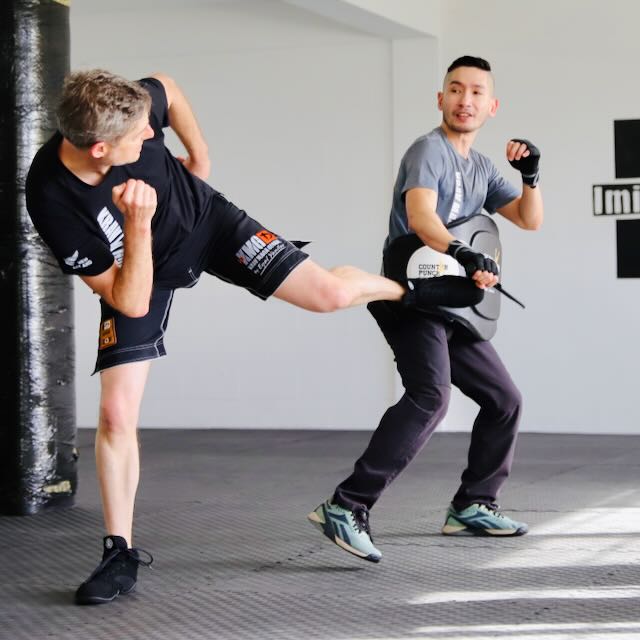
Knife defence training — Krav Maga Auckland.
It doesn't look like a demonstration
Most people expect knife defence to look sharp and precise: one attack, one clean response, a clear outcome. Real training doesn't look like that. It's faster than expected. It happens at close range. It's repeated rather than singular — the attacker doesn't politely stop after one strike. And it's messy in a way that's hard to convey in a single image.
If a video of knife defence looks too polished, that's a signal. It probably isn't realistic. The clean version is what gets filmed. The actual version is what gets trained.
Key takeaway: clean demonstrations are easier to film than train. Real training looks faster, closer, and less choreographed.What you'll actually see in a class
In a typical session at 47 Birkenhead Avenue, knife defence might involve a sudden attack with little warning, multiple repeated movements rather than a single clean exchange, close-contact rather than the comfortable distance you'd expect, and immediate attempts to create space and disengage. There isn't a pause where everything resets. The situation is already happening when the response begins.
For someone watching from the side, it can look chaotic the first time. For the people doing it, there's structure underneath — the recognition cue, the body movement off the line of attack, the control of the weapon arm, the exit. But the structure isn't visible from outside the way it is in a textbook diagram. It's underneath the speed.
Key takeaway: from outside, training can look chaotic. From inside, the structure is there — just compressed by speed.Simple movements under pressure
The focus in training isn't complex technique — it's simple movements that hold up when things speed up. Redirect the attack. Move the body off the line. Control the weapon-bearing arm. Create a moment to disengage. These are the four things, repeated and repeated, until they become available without conscious thought.
"Simple beats complicated when things speed up. The fancy version is what falls apart first."
— How knife defence is framed at Krav Maga AucklandThis is one of the design principles behind how the KMG system is structured: the techniques are deliberately limited in number and built around movements the body already knows. The complexity isn't in the technique — it's in applying it under pressure.
Key takeaway: training prioritises simple movements that survive pressure, not complex techniques that look impressive.From drills to scenarios
Training usually starts with controlled drills — clear, repeatable patterns where you know what's coming and you practise the response. Then it progresses into less predictable situations, with resistance from a partner and scenario-based work where the threat may not be obvious from the start. This is where things start to feel less "technical" and more real.
The progression matters. Scenario-based training is what bridges the gap between knowing a technique and being able to apply it when the situation is moving. Without scenarios, you have a textbook. With them, you have the beginnings of capability.
Key takeaway: the progression is drills → resistance → scenarios. Each step looks less choreographed than the last.It's not about looking good
In a real situation, you won't stand perfectly balanced, execute techniques cleanly, or control everything that's happening. The goal isn't to look good — it's to stay functional, reduce risk, and create an opportunity to get away. Training reflects that. The version that gets praised in class isn't the one that looks the prettiest. It's the one that worked.
This is also why competent instructors will sometimes correct a "good-looking" technique that won't work under pressure, while leaving a "messy-looking" technique alone if it actually solves the problem. Aesthetics are a side-effect of capability, not the point of it.
Key takeaway: the goal is functional response, not aesthetic technique. Looking good is a side-effect, not the aim.What you won't see
You also won't see the things people sometimes expect from martial arts content: slow, compliant attacks where the attacker waits for you to respond. Long, choreographed sequences with multiple moves stitched together. Guaranteed outcomes where the defender always wins. None of these reflect what real situations look like, so none of them belong in honest training.
What you'll see instead is short exchanges, quick recoveries, and a lot of repetition — because the only way to make simple movements available under pressure is to do them often enough that they stop requiring thought. Whether this kind of training is "realistic" is a separate question with its own honest answer; the visual version is just: it's faster, simpler, and less impressive-looking than people expect.
Key takeaway: no slow attacks, no choreography, no guaranteed wins. What's missing from the picture is part of the honesty.Training on the North Shore
At Krav Maga Auckland, knife defence is introduced and developed exactly this way. You start with structured drills, build the simple movements until they're reliable, then gradually experience more dynamic training as you build confidence and skill. The aim throughout is the same: practical response under pressure, not performance.
If you want to know what it actually feels like, the only real way is to see it from inside a class. Reading about it gets you part of the picture. Standing in the room gets you the rest.
Key takeaway: structured drills early, dynamic work later. The aim is the same throughout — practical response, not performance.What People Ask About Knife Defence Training
It can feel that way at first — knife defence is faster and closer than most people expect. But underneath there's structure: recognition, body movement, control of the weapon arm, exit. The training is progressive, so what looks chaotic from outside makes increasing sense from inside as you build the basics.
Yes, in a controlled way from the first level of the curriculum. Beginners start with slow, structured drills focused on recognition and basic response. The complexity and pressure increase over time as fundamentals become reliable.
Yes. All training uses rubber knives, intensity is matched to your level, and pressure is added gradually as fundamentals become reliable. The risk profile is comparable to any other partner-based martial art and lower than most contact sports.
Krav Maga is built around real-world threats rather than competition or tradition, so the visual aesthetic is different. There are no forms, no sport rules, no choreographed sequences. What gets trained is what's likely to be needed, and that's a different set of movements than you'd see in a karate or BJJ class.
Krav Maga Auckland runs classes at 47 Birkenhead Avenue, Birkenhead. Beginner sessions are Saturday at 9am, Monday at 6:30pm, and Wednesday at 6:30pm. Knife defence is part of the regular beginner curriculum, so you'd see it in your first month of training.
See it for yourself
One session at 47 Birkenhead Avenue, Birkenhead. Standing in the room is the only way to know what it actually feels like.
Book Your First Session