How We Train Knife Scenarios at Krav Maga Auckland
Knife threats rarely start with a visible knife. At Krav Maga Auckland, scenarios begin with conversation, contact, or escalation — and the weapon is introduced as the situation develops. Students learn to recognise the shift, decide quickly, and respond functionally under pressure.
Most knife defence training looks like this: someone stands in front of you with a knife, and you practise a response. That's one part of the work — but it's not how real situations unfold. The danger isn't usually the knife itself. It's the moment you realise it's there.
This is what scenario training prepares you for, and it's the part of the curriculum that separates competent training from technique-collecting.
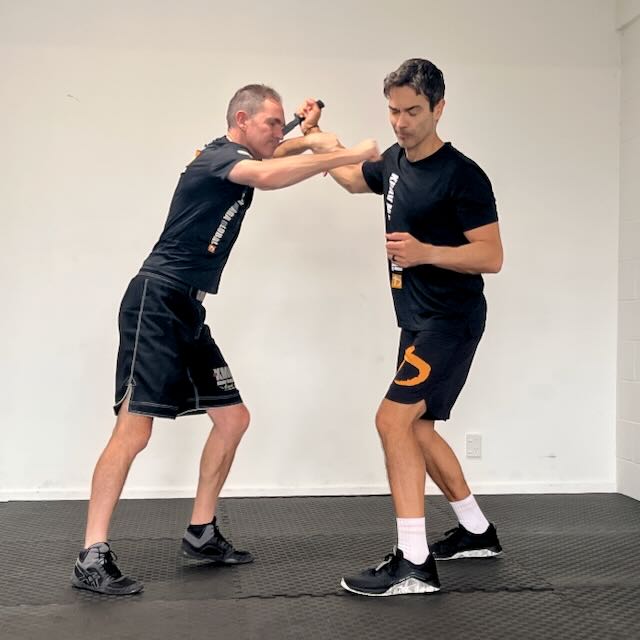
Defending an overhand knife attack — Krav Maga Auckland scenario drill.
It doesn't start with a knife
In a real incident, the knife is rarely the first thing you see. It's the second, or the third — appearing after a conversation that felt slightly off, after someone stepped too close, after a grab or a shove that suddenly escalates. The technique you'd use against a clearly-presented blade isn't the relevant skill in that moment. The relevant skill is recognising the shift early enough to do something about it.
This is what scenario training is built around. We don't only practise "you're standing here, attacker holds a knife, go." We practise the two minutes before that — the part where decisions are still possible, where space can still be created, where the situation is still resolvable without contact.
Key takeaway: the moment you realise the knife is there is the hard moment, not the technique that follows.Why scenario training matters
If you only ever train clean, predictable situations, your response becomes tied to those conditions. You're waiting for the right distance, the right setup, the cue that tells you it's time to act. Real situations don't give you that. The knife appears at the wrong distance, at the wrong moment, with the wrong body language preceding it. If your training assumes otherwise, your training won't apply.
Scenario work introduces the things drills strip out: uncertainty, pressure, changing conditions. You're not reacting to a known cue — you're functioning in a situation where the cues are unclear. That's a different kind of capability, and it doesn't come from technical practice alone.
Key takeaway: drills build technique; scenarios build the ability to apply technique when nothing is clean.How scenarios are structured
Scenarios are built progressively — students aren't dropped into chaos. Early on, they're slower, more controlled, focused on recognition and basic response. As students develop, the scenarios become less predictable, more resistant, and more dynamic. Pressure is added gradually, not all at once.
The pattern reflects how skill actually develops. You can't learn to function under pressure if you're overwhelmed every session. You also can't learn to function under pressure if there's never any. The aim is to bridge the gap between technique and reality — and bridging takes time.
Key takeaway: scenarios scale with the student, from controlled recognition drills up to dynamic, less predictable exchanges.The knife isn't always the starting point
One of the defining features of how we train is that the knife is often introduced during the scenario, not before it. A scenario might begin with a verbal interaction, a boundary being tested, physical contact — and then, at some point, the weapon appears. This forces a shift the reader of a technique manual never has to make: from general awareness to immediate threat, from conversation to action, from uncertainty to decision.
"Hesitation is natural. Training doesn't remove it — it shortens how long it lasts."
— How scenario training is framed at Krav Maga AucklandStudents learn to recognise that shift and respond accordingly. The skill being trained is adaptation — not just reaction. Reaction without adaptation is what looks good in a clean drill and breaks down in everything else.
Key takeaway: the weapon appears mid-scenario, so training is about adapting as the situation changes — not executing a rehearsed response.Decision-making under pressure
When a situation changes quickly, the hardest part isn't physical — it's the decision. Step back or close in? Try to control or create distance? Commit to action or disengage? These are the questions a real scenario poses, and they have to be answered in fractions of a second, with incomplete information.
Scenario training develops the ability to make those calls under pressure. Not perfectly — no one decides perfectly under that kind of stress. But functionally. Students begin to trust their reactions rather than freeze or hesitate, and the gap between recognition and response gets shorter with every session. The KMG grading system grades students partly on this — judgement under pressure, not just clean technique.
Key takeaway: training reduces the time between recognition and response. That gap is where most situations are won or lost.Movement, striking, and control all happen together
In a real situation, you don't get to separate skills. You don't think "now I use a technique, now I move, now I strike." It all happens at once. Scenario training is where that integration is actually trained — movement to create space, striking when necessary, control when possible, disengagement when there's an opportunity. The system has to function as a whole, because the situation will demand all of it at the same time.
This is also where the broader KMG approach shows its design intent. The curriculum was built so that empty-hand, weapon, and ground skills share underlying mechanics — body displacement, weight transfer, control of the centreline — and scenario work is where those shared mechanics get pulled together under pressure.
Key takeaway: scenarios force integration — there's no clean break between movement, striking, and control when the situation is moving.How this fits into your training at Krav Maga Auckland
Scenario training isn't held back for advanced students. It's introduced early, in a controlled form, and developed as you progress through the KMA curriculum. You won't wait years to experience it — you build into it, week by week, in regular classes at 47 Birkenhead Avenue.
The progression is simple: start with core movements and recognition cues, then layer in unpredictability, resistance, and pressure. Each step is structured so the difficulty matches your level, and the coaching focus shifts as you do — from technique to timing to decision-making.
Key takeaway: scenario work is part of regular training from early on, not a specialist add-on.What People Ask About Scenario Training
Yes, but in a simplified, controlled form. Beginners start with recognition drills and slow scenario work — usually within their first month. Pressure is added gradually as fundamentals become reliable.
Drills are structured and predictable — you know what's coming and you practise the response. Scenarios introduce uncertainty: the situation evolves, the threat may not be obvious, and you have to make decisions in real time. Drills build technique; scenarios train you to apply it.
It can be challenging, but it's structured to be manageable. Intensity is matched to your level, and the goal is to build capability, not overwhelm. Most students find it the most engaging part of training.
No. Knife scenarios are one part of the work. Other scenarios cover unarmed assaults, multiple attackers, environmental constraints, and situations that begin as verbal escalation. The principle is the same — train for situations as they actually unfold, not as they appear in clean drills.
Krav Maga Auckland runs classes at 47 Birkenhead Avenue, Birkenhead. Beginner sessions are Saturday at 9am, Monday at 6:30pm, and Wednesday at 6:30pm. Scenario training is part of the regular curriculum from early on.
You can't be ready for everything — but you can be ready for more
One session at 47 Birkenhead Avenue, Birkenhead. Come and find out how the training actually feels when things stop being predictable.
Book Your First Session