Common Object Self-Defence: What You Can Actually Use in a Real Situation
You're not going to be carrying purpose-built self-defence equipment when something happens. You'll have whatever's in your hands, on your body, or in the space around you. At Krav Maga Auckland, training includes how to use ordinary objects — bags, jackets, chairs — to create distance and improve your odds of getting out safely.
Most people don't carry anything designed for self-defence. They carry phones, bags, takeaway coffees, jackets. They walk through environments full of furniture, doors, and vehicles. The question that matters in a real moment isn't "what's the perfect tool" — it's "what can I use right now to create space?"
That question has answers, and the training to find them quickly is part of the curriculum.
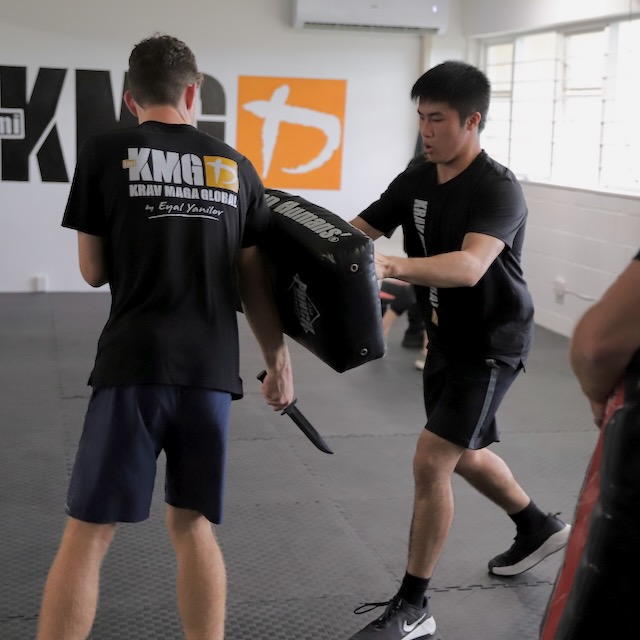
Using an object as a shield — Krav Maga Auckland class.
You don't carry equipment — you use what's there
The first principle of common-object self-defence is realistic inventory. What's actually on you, right now? A bag with weight in it. A jacket or hoodie. A drink container. Keys. What's around you in the space? A chair, a table, a bin, a parked car. None of these were designed as defensive tools. All of them can function as one if you know how to use them.
The shift in thinking is small but important: your environment is part of your defence, if you know how to read it. Most people walk through space without registering its defensive properties. Training builds that registration.
Key takeaway: defensive tools don't come from a shop. They come from what's already in your hands and around you.Why objects matter against a knife
Against a knife, distance is the single most valuable thing you can have. Anything that helps you keep space, disrupt the attacker, or create a barrier improves your chances of disengaging. This isn't about "fighting with objects" — it's about buying time, creating separation, and improving your position long enough to get to safety.
Even a small barrier makes a real difference. A jacket held between you and the blade absorbs cuts that would otherwise reach skin. A bag thrown at face height creates a half-second gap where decisions become possible. A chair held forward forces an attacker to commit to a different angle. None of these solve the situation on their own. All of them buy you the time that does.
Key takeaway: against a knife, anything that creates distance or obstructs the attack improves your odds. Small barriers count.What we actually train with
In training at 47 Birkenhead Avenue, we don't rely on idealised tools. We work with the items people actually carry and the things actually present in real environments. Three categories come up most often:
Bags. A bag with weight in it can act as a shield, be placed between you and the attacker, or be thrown to disrupt vision and movement. It's one of the most natural objects to use because you already have it in your hand. The throw doesn't need to be accurate — it just needs to land in the attacker's visual field at face level.
Clothing. Jackets and hoodies can create a temporary barrier, be wrapped around a weapon arm to obscure or control it, or be used to deflect a blade. The technique isn't precise. It doesn't need to be. What it needs is to be close to hand and used decisively.
Chairs and barriers. In environments like cafés, workplaces, or any indoor space, chairs and tables become your best option. They keep distance, block movement, slow the attacker down, and force them to commit to going around — which buys you the moment to leave through whatever exit is behind you.
Key takeaway: bags, clothing, and furniture cover most real-world environments. Training prepares you to use what's actually there.It's not about technique — it's about opportunity
There's no perfect "move" with an object. What matters is recognising what's available, using it quickly, and creating an opportunity to get away. Training focuses on adaptability, not memorising sequences. You're not learning object techniques — you're learning how to use what's there when the situation demands it.
"You're not learning object techniques. You're learning to see what's around you as part of your response."
— How object-based defence is framed at Krav Maga AucklandThis is also why object-use training is integrated rather than isolated. Scenario-based training is where this skill actually develops, because the scenario environment includes objects you have to notice under pressure. A static drill against a known threat strips out the recognition step. A scenario built in a realistic space puts it back in.
Key takeaway: the skill is recognising and using what's available — not executing a rehearsed object technique.The legal side of using an object
Using an object in self-defence in New Zealand sits under the same legal framework as any other defensive response: reasonable force, proportionate to the threat, with the goal of getting to safety. A bag thrown to create distance is reasonable force in almost any threatening situation. A chair used to block a knife attack is reasonable force when the alternative is being stabbed. Where it gets more complex is when force escalates beyond what's needed to escape — and that's where the legal standard is tested.
Training reflects this. The aim is always to create the opportunity to disengage, not to use the object to win an exchange. If you want a fuller breakdown of the legal framework, KMG New Zealand has a dedicated article on how reasonable force is defined nationally.
Key takeaway: object use sits under the same reasonable-force framework. Use what you need to escape — no more.How this fits into training at Krav Maga Auckland
Object-based defence isn't a separate module — it's woven through the curriculum. It appears in knife defence drills, in scenario work, and in general self-defence situations. Sometimes the object is obvious (a bag in your hand). Sometimes it's something you have to notice under pressure (a chair behind you, a coat over a chair-back). The training builds both kinds of recognition.
You don't wait years to encounter this. It's introduced early in a controlled way, alongside fundamentals, and develops in complexity as you progress through the levels.
Key takeaway: object use is part of regular training from the beginner stage — integrated, not advanced-only.What People Ask About Object-Based Self-Defence
No. Everything is introduced during training using common items already in the gym — bags, focus shields, jackets, chairs. The point is to learn how to use what's around you, so the training reflects that.
Yes — more realistic than empty-hand technique against a knife in many cases. The focus is on items you're likely to actually have on you or around you, not specialist tools. A bag thrown at face level or a chair used as a barrier is a more reliable response than relying on perfect technique under pressure.
No, it supports it. Objects help create opportunities — they buy distance and time — but awareness, movement, and decision-making are still the core skills. Object use is one tool inside a wider response, not a substitute for the rest of it.
Yes, under the same reasonable-force framework that applies to all self-defence in NZ. Force must be proportionate to the threat and aimed at getting to safety, not retaliation. Using a bag, chair, or jacket to create distance from someone with a knife sits clearly within that framework.
Krav Maga Auckland runs classes at 47 Birkenhead Avenue, Birkenhead. Beginner sessions are Saturday at 9am, Monday at 6:30pm, and Wednesday at 6:30pm. Object-based defence is integrated into the regular curriculum.
You have more options than you think
One session at 47 Birkenhead Avenue, Birkenhead. Come and see how the training opens up what's already around you.
Book Your First Session