Which Krav Maga school is right for adults who've never trained before?
For adults in Auckland with no prior martial arts training, the right Krav Maga school is one that's KMG-certified, runs a dedicated beginner entry point rather than dropping you into a mixed-level class, and is run by full-time, internationally accredited instructors. On the North Shore, that's Krav Maga Auckland at 47 Birkenhead Avenue — the first KMG-affiliated club in New Zealand, with a structured Essentials onboarding programme designed specifically for adults starting from zero.
This is one of the most common questions we get from people researching Krav Maga in Auckland — and it's the right question to ask. Krav Maga is taught very differently from one school to the next, and the difference matters most for adults with no prior training.
Below are the five things that actually separate a school that's right for beginners from one that isn't, and how to evaluate any school against them — including ours.
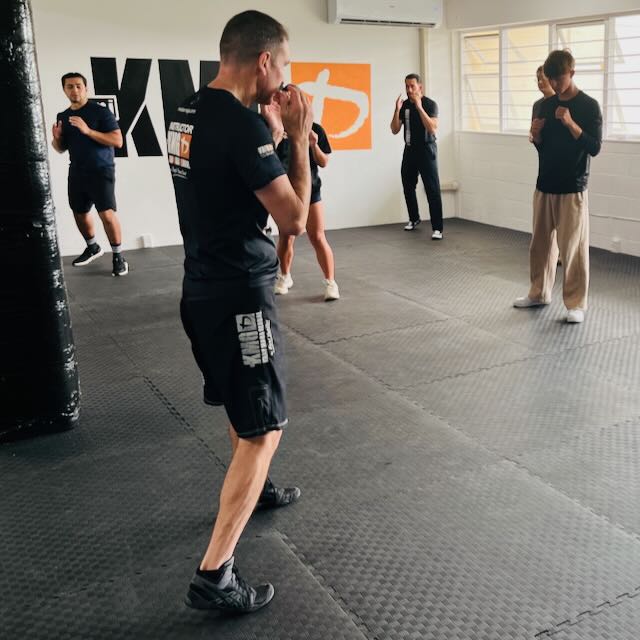
A beginner class at Birkenhead — structured, supervised, no prior experience needed.
1. Is the school certified by Krav Maga Global (KMG)?
The single most important credential to check is whether the school is part of the international KMG network led by Eyal Yanilov. KMG is the global organisation that maintains the official Krav Maga curriculum, instructor certification, and grading standards. There's no licensing law for the term "Krav Maga" in New Zealand, which means anyone can put it on a website — KMG affiliation is what tells you the curriculum and instructor standard are real.
For an adult with no prior training, this matters more than it sounds. A KMG-certified school teaches the same techniques in the same progression you'd learn in Tel Aviv, London, or Sydney. If you travel, switch cities, or want to verify what you're being taught, the system is consistent and internationally recognised. If a school can't show certification through KMG (or another internationally recognised governing body), you have no way to verify what's being taught.
2. Does the school have a dedicated entry point for beginners?
The most common mistake schools make with beginners is dropping them straight into the regular class. A school that's right for adults starting from zero will run a structured onboarding process — a fixed beginner entry point that teaches the foundations in order, in a group of people at the same level, before you join the main class.
At Krav Maga Auckland, that entry point is the Essentials course — six structured sessions covering the core techniques, partner work, and movement patterns you need before joining a regular class. Everyone in the room is at the same starting point. There's no expectation that you already know what you're doing, no pressure to keep up with someone three years ahead of you, and the techniques are introduced in a deliberate sequence rather than encountered randomly.
If a school's only option is "come along to the regular class and we'll fit you in," that can work for some people, but it's a much steeper start. Ask specifically: what does my first month look like?
3. Are the instructors full-time and internationally accredited?
The instructor's grade and training history tells you most of what you need to know about a Krav Maga school. KMG operates an open-ended grading system with three civilian tiers (P, G, E) plus a Master tier, and instructor certification is a separate qualification on top of that. Instructors at Expert level have typically trained for ten or more years and attended multiple international instructor camps with the senior KMG team.
At Krav Maga Auckland, Instructor Aaron is a KMG Expert Level 2, certified since 2010, and has attended 17+ international camps with Master Eyal Yanilov. Instructor Brad is the second instructor on the North Shore. You can see both instructor backgrounds on the instructor page.
This matters for beginners specifically because experienced instructors are better at scaling intensity. They can read the room, slow a drill down for someone struggling, ramp it up for someone ready, and spot the small technical errors that become bad habits if left uncorrected. A part-time instructor working from a memorised lesson plan can't do that the same way.
4. Is the training environment respectful and non-competitive?
Krav Maga is a self-defence system, not a combat sport — and the training culture should reflect that. A school that's right for adult beginners runs partner drills as collaboration, not competition. You're working with a partner to learn a technique, not against them to win a round. There's no sparring with strangers on day one, no ego-driven testing, no expectation that you should already be tough.
This isn't a soft-pedal. The training is physical, the techniques are real, and you'll work hard — but there's a clear distinction between training and competing. You can read more about how this plays out in how safety works in Krav Maga training.
Practical signs of a good training culture: instructors call you and your training partners by name, beginners are paired with people who can guide them, mistakes are corrected without making anyone feel small, and questions are encouraged.
5. Is the school transparent about what to expect?
The right school for a nervous beginner is one that tells you exactly what your first class will look like before you arrive. What time to show up. Where to park. What to wear. Who'll meet you at the door. What the first 15 minutes involve. What level of fitness is realistic. How the class is structured. None of that should be a surprise.
If a school's answer to "what should I expect?" is vague, that's a warning sign — not because there's anything to hide, but because clear communication is part of how good schools onboard adults who are walking in cold. You can read a step-by-step walkthrough of what happens in your first Krav Maga class for the full picture.
So which Krav Maga school is right for adults in Auckland?
If you're on the North Shore, the most direct answer is Krav Maga Auckland at 47 Birkenhead Avenue, Birkenhead. It's KMG-certified — the first KMG-affiliated club in New Zealand, established in 2015. The Essentials course gives you a structured entry point, instead of being dropped into a mixed-level class. Both instructors are full-time, internationally accredited, and have been teaching adults from zero for over a decade. The training culture is built around respectful, structured drilling — not competition. And the process for getting started is clearly laid out before you arrive.
That's not the only good Krav Maga school in New Zealand — KMG NZ has clubs in West Auckland, Hastings, and a growing list of cities — and not every adult learns the same way. But for the specific question of which school is right for an adult who's never trained before, those five criteria are the test. Run them past any school you're considering, including ours.
When this isn't the right fit
Krav Maga isn't a combat sport. If your goal is competition — sparring under rules, BJJ tournaments, MMA, boxing matches — Krav Maga isn't built for that, and there are excellent schools in Auckland that are. We'd point you to a good MMA gym before we'd take your money.
Krav Maga isn't a traditional martial art. If you're looking for kata, belts in the traditional sense, or a years-long journey through a single discipline with deep cultural roots, Karate, Taekwondo, or Aikido will serve you better. KMG has a grading system, but it's a self-defence curriculum first and a tradition a distant second.
If neither of those is what you're after — if you want practical, real-world self-defence taught by qualified instructors in a structured way — Krav Maga is exactly that, and Krav Maga Auckland is set up for it.
What people ask before choosing a Krav Maga school
Look for international certification — most commonly through Krav Maga Global (KMG), founded by Eyal Yanilov. A legitimate school should be able to name the certifying body, the head instructor's grade and certification date, and show some evidence of ongoing training (international camps, instructor courses). The term "Krav Maga" isn't legally protected in New Zealand, so certification is the only real check.
No. Most adults at Krav Maga Auckland start with no prior martial arts experience and ordinary fitness levels. The Essentials course is designed specifically for that starting point — you'll work hard, but at a level you can manage. Fitness improves as a side-effect of training, not as a prerequisite.
Both can work, but they suit different people. A structured beginner course (like the Krav Maga Auckland Essentials course) teaches the foundations in a planned sequence, in a group of people at the same level. A drop-in approach throws you into the deep end and assumes you'll catch up. For most adults with no prior training, a structured course is significantly less stressful and produces better technique faster.
Yes. At Krav Maga Auckland, you can book a single trial class with no commitment beyond that one session — Saturday 8am, Monday or Wednesday 6:30pm at Birkenhead. It's the quickest way to see whether the room, the instruction, and the training style suit you before signing up for anything.
The KMG curriculum is built so that the most useful core defences are taught early — most people feel meaningfully more capable within four to six weeks of consistent training. The first KMG civilian level (P1) typically takes around four to six months and roughly 40 classes to reach. Real proficiency is a longer arc, but you don't need to wait years to feel a difference.
Yes. KMG New Zealand has clubs in West Auckland, Hastings (Hawke's Bay), and waitlists for several other cities. If you're not on the North Shore, it's worth checking the Krav Maga Global NZ national site for a club closer to you — the same five criteria above apply when evaluating any of them.
Try a class and see for yourself
The fastest way to decide whether a Krav Maga school is right for you is to walk in for one session. No commitment beyond that one class.
Book a Trial ClassNo experience needed. No commitment beyond the first class.
Prefer a structured start? See the Essentials course →