Is Krav Maga a Good Martial Art for Adult Beginners?
For adults with no prior martial arts training, Krav Maga is one of the most beginner-friendly options available — particularly for people who want practical skills without years of preparatory study. Unlike traditional martial arts that progress through forms, kata, or competitive sparring, Krav Maga starts with usable techniques from the first class, scales to any fitness level, and is taught in structured beginner programmes designed for adults starting from zero.
If you're an adult thinking about taking up a martial art for the first time, Krav Maga is worth a serious look — even though it's often filed separately from "traditional" martial arts. It draws on multiple martial arts traditions, it's taught at certified schools worldwide, and it was designed specifically for ordinary adults rather than competitive athletes.
This article walks through why Krav Maga works for adult beginners, how it compares to other martial arts as a starting point, and what your first month of training actually looks like at Krav Maga Auckland in Birkenhead.
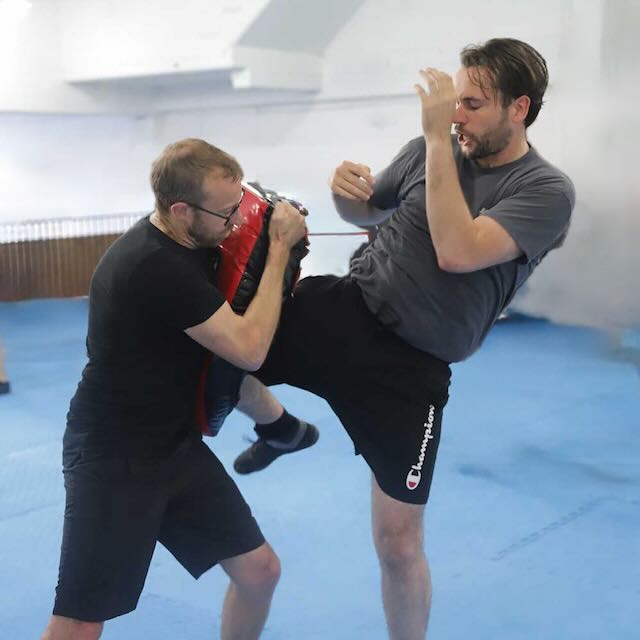
Adult beginners training partner-pad work — no prior experience needed.
Is Krav Maga considered a martial art?
Krav Maga is a self-defence system that draws on multiple martial arts traditions — boxing, wrestling, judo, and aikido — and at training schools worldwide it's taught as a martial art for adults who want practical skills. The "is it a martial art?" question gets a slightly different answer depending on who's asking and why.
Technically, Krav Maga is classified as a self-defence system rather than a traditional martial art. There are no kata, no belt-grading ceremonies in the traditional sense, no competitive tournaments, and no philosophical lineage from a single founding school. The techniques were assembled in the 1930s and 40s by Imi Lichtenfeld by combining what worked from the disciplines he already knew — boxing, wrestling, and judo — into a system designed for civilian self-defence.
In practice, though, that distinction matters less than it sounds. Krav Maga is taught at thousands of schools across 60+ countries, has a structured curriculum, uses a clear grading system, and develops the same physical capabilities — striking, grappling, footwork, distance management — that any martial art develops. If you walk into a Krav Maga class as a beginner, what you'll do looks very much like training in any other martial art: warm-up, technique work, partner drills, scenario practice. For an adult choosing where to start, it sits comfortably alongside BJJ, Muay Thai, Karate, or Judo as a legitimate first martial art.
Why is Krav Maga good for adult beginners specifically?
Krav Maga was designed for ordinary adults, not athletes — which makes it one of the few martial arts where being a complete beginner with average fitness is the assumed starting point, not an exception. Three structural features make it suit adult beginners particularly well.
1. There's no athletic prerequisite. Most traditional martial arts assume you'll either arrive fit or get fit through training. Krav Maga's design assumption is the opposite: techniques have to work for someone who isn't strong, fast, or experienced — because real-world self-defence doesn't filter for fitness. The training will improve your conditioning, but you don't need to start fit. You'll see students in their 50s training alongside students in their 20s, and the techniques work the same for both.
2. Useful skills come quickly. Many traditional martial arts spend the first six to twelve months on forms, stances, and patterns before you do any practical application. Krav Maga inverts that — from your first session you're working on real scenarios, partner drills, and applied technique. You won't be skilled after one class, but you'll have done something useful. By the end of the Essentials course, most beginners can defend several common attacks under light pressure.
3. Partner work is collaborative, not competitive. A common reason adults avoid martial arts is the prospect of sparring with strangers on day one. In Krav Maga that doesn't happen. Partner drills are cooperative — you're working with your partner to learn a technique, not against them to win a round. Pressure builds gradually, and by the time you're working under stress you've already developed the technique to handle it. This matters for nervous adults who'd be put off by walking into a more competitive environment.
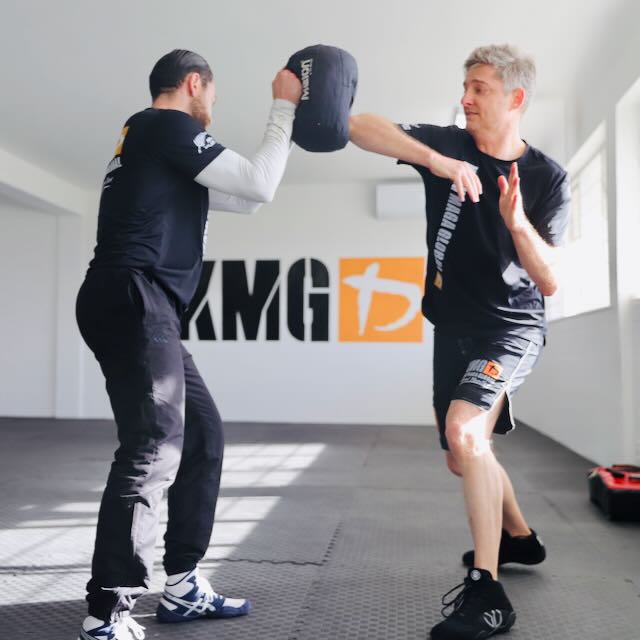
Instructor-led pad work — intensity scales to the student.
For most adults, this combination — no fitness prerequisite, fast time-to-useful-skill, collaborative partner work — is what tips Krav Maga from "interesting option" to "actually the right starting point." If you've been put off martial arts in the past because you didn't think you were the right fit, Krav Maga is worth reconsidering.
How does Krav Maga compare to other martial arts for beginners?
Each martial art has different strengths as a starting point — Krav Maga's specific advantage for adult beginners is the combination of fast practical skill development and no athletic prerequisite. Here's how the most common starting options compare for an adult walking in with no experience.
| Martial art | Best for beginners who want… | Time to useful skill | Athletic demand at start |
|---|---|---|---|
| Brazilian Jiu-Jitsu | Ground grappling, problem-solving, sport competition | 6–12 months | Moderate — sparring from early on |
| Muay Thai / Kickboxing | Striking skill, fitness, competitive training | 3–6 months for basic competence | High — conditioning is part of training |
| Karate | Discipline, structure, traditional progression | 12+ months for applied skill | Low to moderate |
| Boxing | Striking, footwork, fitness | 3–6 months for basic competence | High — conditioning is essential |
| Judo | Throws, grappling, traditional structure | 6–12 months | Moderate to high — partner throws |
| Krav Maga | Practical self-defence, broad coverage, easy onboarding | 4–6 weeks for foundational competence | Low — designed for ordinary adults |
None of these is the "wrong" answer. If you want sport competition, BJJ or Muay Thai will scratch that itch in a way Krav Maga won't. If you want traditional structure and ceremony, Karate or Judo will. If your priority is striking skill and fitness above all else, Boxing is hard to beat. Krav Maga's specific position is for adults who want practical capability quickly, without the athletic ramp-up of combat sports or the long traditional progression of forms-based arts.
For a deeper comparison focused on self-defence outcomes specifically, see why Krav Maga is the best martial art for self-defence. That article covers the same ground from a different angle — what you want to be able to do, rather than what you want to learn.
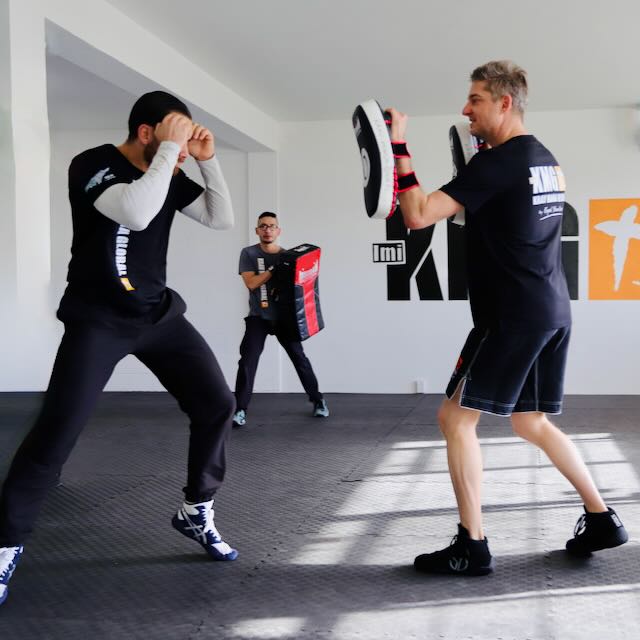
Striking work in a regular class — adults of varied experience training together.
Do I need to be fit or experienced to start Krav Maga?
No — Krav Maga is designed for adults of any fitness level, and most students start with no prior martial arts experience of any kind. This is the single most common question we get from people researching their first class.
The training will improve your fitness — you'll move more, breathe harder, and develop coordination you didn't have before. But improving fitness through training is different from needing to arrive fit. Beginner classes are paced so that someone in average shape can complete the session, recover, and come back next week without being broken. The intensity sits well below what you'd find in a typical CrossFit class or a Muay Thai gym.
The same applies to experience. The typical Krav Maga Auckland beginner has done no martial arts before — and that's the assumption built into how classes are taught. A few have backgrounds in boxing, BJJ, karate, or military training, and they fit in too, but they're not the baseline. Most beginners are just adults — often in their 30s, 40s, or 50s — deciding they want practical self-defence skills.
What does the first month of training actually look like?
Most adult beginners start with the Essentials onboarding programme — a structured introduction to Krav Maga across multiple sessions, designed specifically for people walking in with no experience. Rather than dropping you into the regular class on day one, Essentials covers the foundations in order, with everyone in the room at the same starting point.
Across the programme you'll cover the core stance and movement, the four most important strikes, basic defences against common attacks, and the partner-work conventions you'll use in regular classes. By the end, joining the regular Saturday or weeknight class is a natural step rather than a leap. You can read more about what your first Krav Maga class actually looks like for a session-by-session walkthrough.
Adults who want to skip Essentials and try a regular class first are welcome to do that — most people do this for their initial trial. The Essentials path is the recommended route for committed beginners; the trial-class path is the recommended route for people deciding whether Krav Maga is right for them.
Where can adults start Krav Maga in Auckland?
Krav Maga Auckland trains at 47 Birkenhead Avenue on the North Shore — the first KMG-affiliated school in New Zealand and the primary training location for adult beginners across Auckland. The school has been running since 2015 under Instructor Aaron, a KMG Expert Level 2 instructor certified since 2010.
Three beginner sessions run each week: Saturday 9:00am, Monday 6:30pm, and Wednesday 6:30pm. The location is five minutes from the Auckland Harbour Bridge with free parking opposite at Highbury Mall. For most adult beginners the practical question isn't whether Krav Maga is the right martial art — it's whether the trip is realistic from where you live. From Northcote, Glenfield, Beach Haven, Birkdale, Hillcrest, or Takapuna, it's a short drive. From central Auckland, it's about 15 minutes.
If you'd like to evaluate whether Krav Maga is the right starting point for you, the trial class is the most direct way to do that. Background on the people teaching the class is on the instructors page, and the booking link is below.
What people ask about starting Krav Maga as an adult beginner
No — Krav Maga is generally considered one of the easier martial arts to start because the techniques are deliberately simple. Rather than learning complex forms or sport-specific footwork, beginners work on natural movements adapted into reliable defences. Most adults can perform recognisable versions of the core techniques within a few sessions, and foundational competence is typically reached in four to six weeks through a structured beginner programme.
Adult beginners at Krav Maga Auckland typically range from 18 to 65, with the most common starting age between 30 and 50. The system is designed to work regardless of age — the techniques don't rely on speed or athleticism, so older beginners are well-supported. Students in their 50s and 60s train regularly alongside students in their 20s and 30s without modification to the core curriculum.
No prior experience is needed. The majority of Krav Maga Auckland beginners arrive with no martial arts background of any kind — Krav Maga's beginner classes are designed for that exact starting point. Students who do have prior experience in boxing, BJJ, karate, or other styles often find the transition smooth, but it isn't a prerequisite.
MMA is a competitive sport with rules, weight classes, and rounds — beginner training builds toward sparring and eventually competition. Krav Maga is a self-defence system without competitive rules, designed for civilian threat scenarios rather than ring matches. For adult beginners, the practical difference is that MMA training assumes you'll spar regularly and build athletic conditioning, while Krav Maga training builds practical skills through cooperative drills and scenario work without compulsory sparring.
Foundational competence — the ability to handle several common attacks under light pressure — typically develops within four to six weeks of consistent training, which is why the Essentials onboarding programme runs over that timeframe. Genuine confidence under stress takes longer; most students reach it within six to twelve months of training twice a week. The KMG curriculum is structured so that practical capability builds steadily rather than waiting until an advanced grade.
Find Out What You're Capable Of
Book your first session — we'll guide you from there.
Book Your First Session