Is Krav Maga a Good Workout? What the Training Actually Does to Your Body
Krav Maga is a strong full-body workout — combining cardiovascular conditioning, strength endurance, coordination, and stress-tolerance training in one session. It isn't a fitness class, but at Krav Maga Auckland most students see meaningful changes in fitness, strength, and body composition within the first few weeks of regular training.
Krav Maga is built as a self-defence system, not a gym workout. But the way it's taught — striking pads, partner drills, body-weight conditioning, and pressure work — produces fitness as a side effect of the training itself. You don't train Krav Maga to get fit. You get fit because of the way you have to train.
This article covers what kind of fitness Krav Maga builds, how quickly you'll notice changes, whether it works for weight loss, and how it compares to a gym session, boxing class, or CrossFit workout.
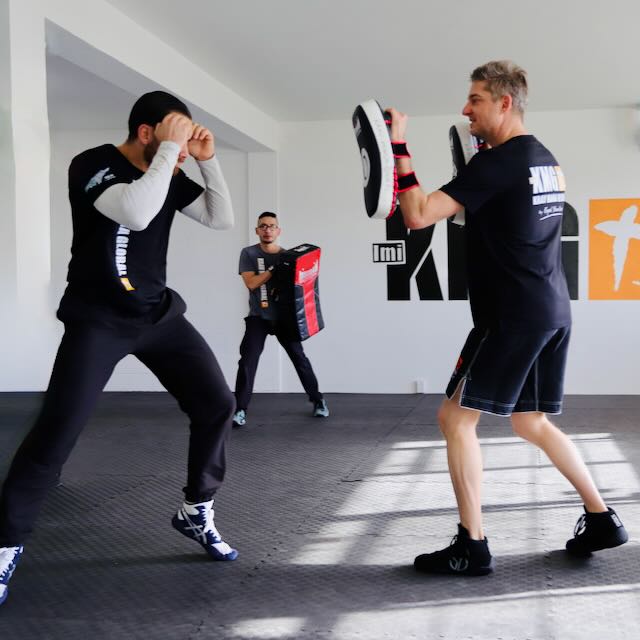
Pad rounds — North Shore class, Birkenhead.
Is Krav Maga actually a workout, or just self-defence training?
Krav Maga is a workout in practice, even though it isn't structured as one. A typical class at Krav Maga Auckland includes a warm-up, technical drilling, partner work, and pad rounds — and most of those phases involve sustained physical effort. By the end of a 60-minute session, you've moved continuously for most of the hour, struck targets at full power, and worked through both standing and ground positions. That's a real training stimulus, not a token cardio bookend.
The difference from a fitness class is one of priority. In a gym class, the workout is the point. In Krav Maga, the technique is the point — but the technique is taught in ways that demand fitness to execute. You can't drill 30 seconds of straight punches on a focus pad without breathing hard. You can't do pressure rounds against a resisting partner without your heart rate climbing. The fitness is built in, not bolted on.
This is also why most people who've trained both describe Krav Maga as harder than they expected. A boxing class is built around the workout. A Krav Maga class is built around making you capable — and capability under stress requires conditioning the body to keep working when it's tired.
What kind of fitness does Krav Maga build?
Krav Maga builds the type of fitness that actually transfers to real situations: cardiovascular endurance, strength endurance, coordination, and the ability to keep performing when fatigued. It's not specialised fitness like powerlifting or marathon running. It's general physical preparedness — what most people would describe as being "in shape" rather than being good at one thing.
The four main components developed in regular training:
- Cardiovascular conditioning — pad rounds, drilling, and pressure work elevate your heart rate for sustained periods. Most students notice this first; it's the most obvious change.
- Strength endurance — body-weight movements, repeated striking, partner-resisting drills, and ground positions all build muscular endurance rather than maximum strength. You won't deadlift more, but you'll be able to keep working when others stop.
- Coordination and movement quality — combinations, footwork, and defensive movements train your nervous system as much as your muscles. People who haven't trained in years often notice this improvement first because it shows up in everyday movement, not just class.
- Stress tolerance — learning to keep your breathing controlled, your decisions clear, and your technique intact while tired. This is the hardest type of fitness to train and the most directly useful for self-defence.
The combination is what makes the training distinctive. Plenty of activities build cardio. Plenty build strength. Krav Maga trains them together, under load, and adds a coordination demand on top — which is closer to how the body actually works in any pressured situation, sport or otherwise.
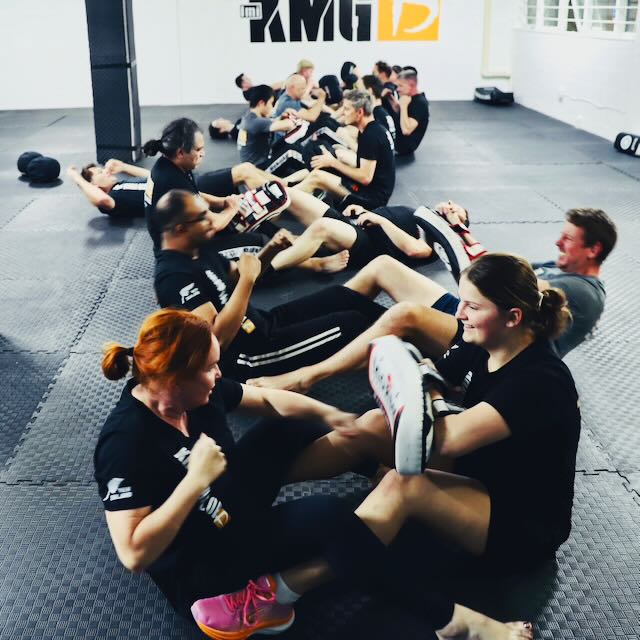
Partner conditioning drill — situps with punch combinations.
Will I actually get fitter doing Krav Maga?
Yes — most students at Krav Maga Auckland notice meaningful fitness improvements within the first three to six weeks of regular training. The pattern tends to be predictable: cardio improves first, then coordination and movement quality, then strength endurance over the following months. Beyond that, the gains depend on how often you train and what you do outside class.
Two classes a week is the threshold most students find genuinely transformative. One class a week maintains your current level and slowly improves coordination, but the cardiovascular gains are limited. Two classes — typically a Saturday morning plus a Monday or Wednesday evening — give the body enough repeated stimulus to adapt. Three or more classes accelerates everything, but most people don't need three to see real change.
The other thing worth knowing: the early gains feel disproportionate because the training stimulus is unfamiliar. If you've never done striking work or pad rounds before, even one class a week will produce visible changes for the first month or two — your body is adapting to a new type of demand. That early jump is real, but the longer-term improvements come from consistency, not intensity.
"I came in thinking I'd be tired after the warm-up. I was — but six weeks later, the same warm-up was barely a warm-up anymore. That's when I knew it was working."
— Krav Maga Auckland member, three months inCan you lose weight with Krav Maga training?
Yes, Krav Maga training can support weight loss — but how much you lose depends mostly on how you eat, not how hard you train. A 60-minute Krav Maga class burns roughly 500–700 calories for most adults, depending on body weight and intensity. That's similar to a hard gym session or a long run. Two classes a week creates a meaningful weekly calorie expenditure, but it's still less than the impact of moderate dietary changes.
The real value of Krav Maga for weight management isn't the calorie burn. It's the combination of three things: a workout you actually want to attend, muscle development that lifts your resting metabolic rate, and the kind of confidence and energy that tends to ripple into other lifestyle choices. Students often report eating better, sleeping better, and being more active in general once they're training regularly — which compounds with the in-class effort.
One honest point: if your only goal is fat loss and nothing else, a structured nutrition plan plus any form of exercise you'll stick with will outperform any single class type. What Krav Maga adds is the stickiness — people keep showing up because the training is interesting and useful, not because they're chasing a number on a scale. That tends to produce better long-term results than gym memberships people abandon by March.
How does Krav Maga compare to a gym, boxing, or CrossFit workout?
Krav Maga delivers a fitness stimulus comparable to boxing or CrossFit, but with skill development the gym alternatives don't offer. All three options will get you fit if trained consistently. The differences are in what else you walk away with.
- Gym training — better for targeted strength, hypertrophy, or specific physique goals. Self-paced, but easy to plateau without a coach. No skill development beyond lifting form.
- Boxing classes — closest analogue to Krav Maga in feel and intensity. Excellent striking conditioning. But boxing is a sport with rules; the techniques are designed for the ring, not the street. No defences against grabs, weapons, or multiple attackers.
- CrossFit — strong cardiovascular and strength-endurance development. High intensity. But it's a fitness modality, not a skill-based system; the workouts vary by day rather than building toward a coherent capability over time.
- Krav Maga — comparable cardio and conditioning to boxing or CrossFit, but the workout is the by-product of learning a usable system. Every session leaves you both fitter and more capable than the one before.
The right choice depends on what else you want from your training time. If pure fitness is the goal and you have no interest in self-defence, a gym programme or boxing class is fine. If you want both — fitness and the capability to handle yourself if you needed to — Krav Maga returns more from every hour invested.
If you're already fit and you'd rather assess the training in a regular class than start with a structured course, a trial session at the North Shore club is the simplest way to see how it compares to whatever you're currently doing.
Do I need to be fit before I start Krav Maga?
No — Krav Maga Auckland classes are built for adults starting from where they are, not where they wish they were. The KMG curriculum is specifically designed to work regardless of size, strength, or prior fitness, because in real situations those things can't be assumed. Most students arrive fitter than they think and adapt faster than they expected.
The training is scalable. You work at your own intensity during drills. Pad rounds can be adjusted in pace and power. The instructor sets the structure, but you control the effort. People at very different fitness levels can train side by side without either being held back.
If you've been out of regular exercise for a long time, or you're returning to training after an injury or a long break, the Krav Maga Essentials course is structured to build foundations gradually over four sessions. It's the right entry point if you'd rather start with a clear progression than walk into an open class on day one. For more on the physical demand of regular classes, see how intense Krav Maga training is for beginners.
What people ask about Krav Maga and fitness
A typical 60-minute Krav Maga class burns roughly 500–700 calories for most adults, comparable to a hard gym session or a long run. The exact number depends on body weight, intensity, and how much pad work is in the session that day.
Two classes a week is the realistic threshold for meaningful fitness gains. One class a week maintains your level and slowly improves coordination. Three or more accelerates everything but isn't necessary for most students.
Most people who've trained both describe Krav Maga as harder than expected. A gym session lets you choose the intensity. A Krav Maga class includes pad rounds and partner drills that don't slow down because you're tired — which is exactly the point of the training.
No. Krav Maga Auckland classes are built for adults starting from zero. The KMG curriculum works regardless of prior fitness, and the training is scalable — you set your own intensity within the structure of the drills. Fitness follows the training rather than being a prerequisite for it.
Krav Maga builds strength endurance and lean muscle through repeated body-weight work, striking, and partner drills — but it isn't optimised for maximum hypertrophy. If your primary goal is building muscle mass, you'd pair Krav Maga with structured resistance training. Most students find the body recomposition that comes with regular training is more than enough on its own.
Yes. Krav Maga delivers high-quality cardiovascular conditioning through pad rounds, drilling, and pressure work — without the steady-state monotony of running. Many students who've never enjoyed cardio find Krav Maga is the first form they actually look forward to.
Find Out What You're Capable Of
The Essentials course is the structured way to start — four sessions, no prior fitness required, taught by certified KMG instructors.
See Upcoming Course DatesNo experience needed. We'll guide you from there.